

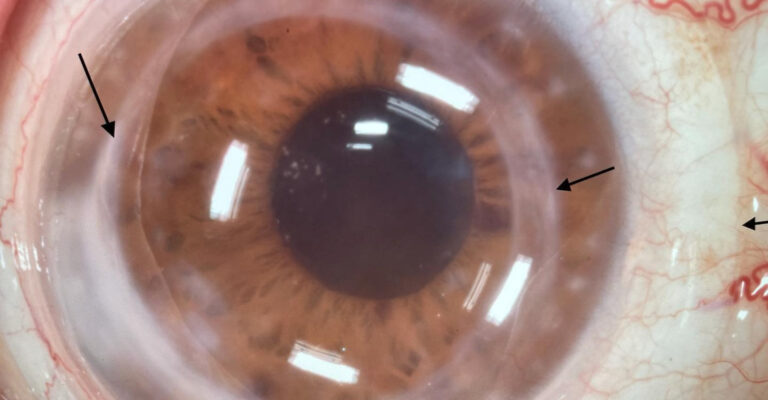
A scleral lens is a large-diameter, rigid gas-permeable contact lens that vaults over the cornea and lands on the tissue covering the sclera, the white part of the eye. Before application, the lens is filled with sterile, preservative-free saline. This creates a fluid reservoir between the lens and the cornea.
For selected patients, that design can create a smoother optical surface over an irregular cornea or help protect the ocular surface during wear. A scleral lens is still a medical contact lens and requires an individualized examination, fitting, handling instruction, and follow-up.
For a broader overview of candidacy, fitting, benefits, limitations, and care, visit Eye Freedom’s scleral lenses guide.
How Does a Scleral Lens Work?
Unlike a conventional soft contact lens, a scleral lens is designed to clear, or vault, the cornea. Its outer landing area rests on the conjunctival tissue over the sclera. The space beneath the center of the lens is filled before application, forming a fluid reservoir over the cornea.
The front surface of the lens can provide a more regular refractive surface when the cornea is irregular. The fluid reservoir may also support comfort and corneal protection in selected people with severe dry eye or ocular surface disease. Results depend on the diagnosis, lens design, eye health, and quality of the fit.
How Is a Scleral Lens Different From Other Contact Lenses?
| Feature | Scleral lens | Soft contact lens | Corneal GP lens |
|---|---|---|---|
| Where it rests | On tissue over the sclera while vaulting the cornea | Primarily over the cornea | On the cornea |
| Material | Rigid gas-permeable | Flexible | Rigid gas-permeable |
| Fluid reservoir | Yes, when filled before application | No comparable reservoir | No comparable reservoir |
| Common role | Complex corneal shape, ocular surface disease, or conventional lens intolerance | Routine refractive correction for suitable eyes | Refractive correction, including some irregular corneas |
The appropriate lens type is determined by examination findings and the patient’s visual, ocular-surface, and handling needs. Larger is not automatically better, and not every complex eye requires a scleral design.
Who May Be Evaluated for a Scleral Lens?
A specialty lens evaluation may be considered for people with:
- Keratoconus, corneal ectasia, or another irregular corneal shape.
- Corneal scarring, degeneration, or dystrophy that limits vision with glasses.
- Severe dry eye or ocular surface disease when a scleral lens is clinically appropriate.
- Corneal irregularity after LASIK, RK, PRK, trauma, or corneal transplantation.
- Difficulty obtaining useful vision or comfort with conventional contact lenses.
These conditions do not automatically make someone a candidate. Dr. Edward Boshnick evaluates the cornea, ocular surface, eyelids, tear film, prescription, prior surgery, handling ability, and visual goals before recommending a lens design.
What Happens During a Scleral Lens Fitting?
- Eye-health and vision assessment: Symptoms, diagnoses, prior procedures, current treatments, and visual needs are reviewed.
- Corneal and ocular-surface measurements: Diagnostic imaging may help document corneal shape and other findings relevant to lens selection.
- On-eye evaluation: A diagnostic lens is assessed for corneal clearance, landing, stability, comfort, and visual performance.
- Custom design and refinement: Lens parameters may be adjusted over one or more visits.
- Training and follow-up: The patient learns safe application, removal, cleaning, disinfection, and filling procedures. Follow-up checks the fit, eye health, comfort, and vision.
Learn why these measurements and follow-up visits matter in Eye Freedom’s custom scleral lens fitting guide.
Potential Benefits and Limitations
Depending on the eye and the fit, a scleral lens may improve visual clarity or stability, reduce movement compared with smaller lenses, or maintain a fluid environment over the cornea during wear. No specific result can be guaranteed.
Possible challenges include learning application and removal, lens awareness, air bubbles, midday fogging, deposits, solution sensitivity, difficulty removing a lens, and the need for design changes. Some eye conditions or anatomical findings may make scleral lens wear inappropriate or require additional precautions.
Scleral Lens Safety and Care
Use only the lens-care and filling products prescribed for your lens system. Wash and dry your hands before handling lenses, use fresh solution, and keep lenses and storage cases away from tap water. Do not sleep, swim, or shower in scleral lenses unless your eye-care professional has given specific instructions for your medical situation.
Remove the lens and contact the practice promptly if you develop pain, marked redness, light sensitivity, discharge, an unexpected decrease in vision, or persistent difficulty removing the lens. These symptoms should not be treated as a normal adjustment.
Frequently Asked Questions
Is a scleral lens the same as a scleral contact lens?
Yes. The terms generally describe the same large-diameter gas-permeable contact lens design. A scleral contact lens is different from a scleral buckle used in retinal surgery or an intraocular lens placed inside the eye.
Does a scleral lens touch the cornea?
A properly designed scleral lens is intended to vault the cornea, but clearance and settling must be assessed on the eye. The landing area rests on the conjunctival tissue over the sclera.
Are scleral lenses only for keratoconus?
No. They may be evaluated for keratoconus and other irregular corneas, severe ocular surface disease, post-surgical corneal irregularity, scarring, or conventional lens intolerance. The diagnosis alone does not determine candidacy.
Are scleral lenses comfortable?
Many patients find a well-fitted scleral lens comfortable because it vaults the sensitive cornea, but comfort varies. Persistent discomfort, pain, redness, or vision changes require evaluation.
How do I know which scleral lens is right for me?
The design depends on corneal and scleral shape, ocular-surface health, prescription, prior surgery, handling needs, and the findings from an on-eye assessment. There is no single design that is best for every patient.
Medical Sources
- American Academy of Ophthalmology: Update on Scleral Lenses
- CDC: Cleaning, Disinfecting, and Storing Contact Lenses
- Peer-reviewed review: Potential contraindications to scleral lens wear
This page is educational and does not replace an eye examination, diagnosis, or individualized treatment plan.
Request an evaluation with Dr. Edward Boshnick or read additional patient questions in the Scleral Lens FAQ.
