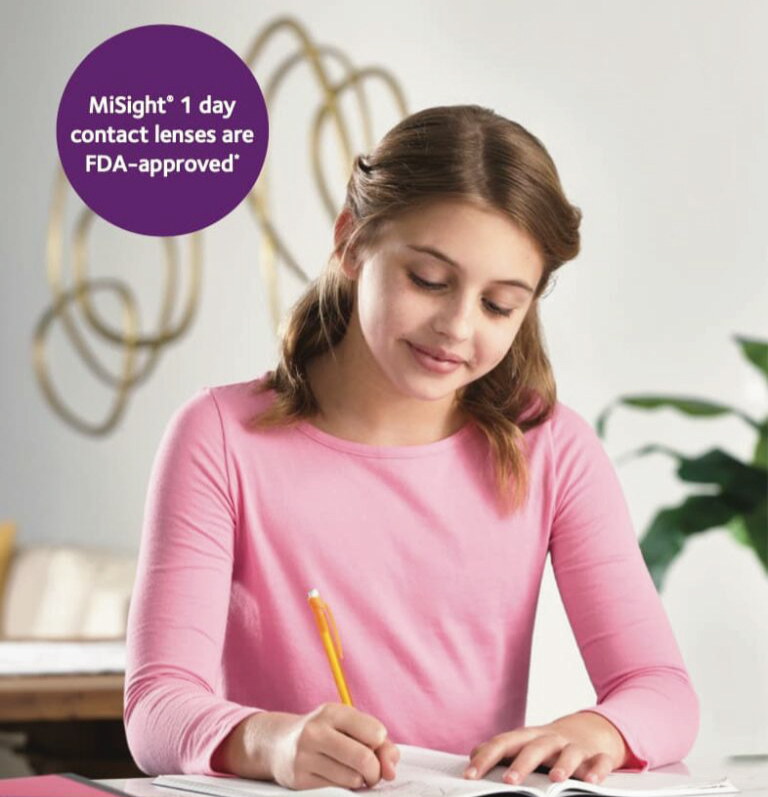
MiSight 1 Day is a prescription, daily disposable soft contact lens that corrects nearsightedness while its dual-focus design is intended to slow myopia progression in eligible children. This page explains the fitting, handling, and follow-up process at Eye Freedom. For current product specifications and the exact U.S. indication, read the MiSight 1 Day parameters and FDA guide.
The current U.S. FDA indication applies to children with non-diseased eyes who begin treatment at ages 8 to 12, have -0.75 to -4.00 diopters of spherical-equivalent myopia, and have no more than 0.75 diopters of astigmatism at initiation. Meeting those numbers does not confirm candidacy. Dr. Edward Boshnick must also evaluate eye health, vision, fit, contact-lens readiness, and the family’s ability to follow the wearing and follow-up plan.
What MiSight 1 Day Is Designed to Do
MiSight combines distance-correction zones with treatment zones that create myopic defocus in front of the retina. The lens is designed to provide useful distance vision while reducing the visual signal associated with excessive eye growth.
In the three-year randomized clinical trial, the MiSight group had less average change in prescription and axial length than children wearing a single-vision daily disposable control lens. Those results describe group averages, not a guaranteed result for an individual child. MiSight does not cure myopia, permanently stop eye growth, or remove the need for glasses as a backup.
What Happens During Fitting and Follow-Up?
History and progression review: Bring prior prescriptions and eye-growth measurements when available. Dr. Boshnick reviews the child’s visual needs, rate of change, eye health, and previous correction.
Eye and vision examination: Refraction, binocular vision, corneal and ocular-surface findings, and other measurements appropriate to the child are reviewed before a lens is selected.
On-eye lens assessment: The lens is evaluated for coverage, centration, movement, comfort, and vision. The available prescription range alone cannot establish a healthy fit.
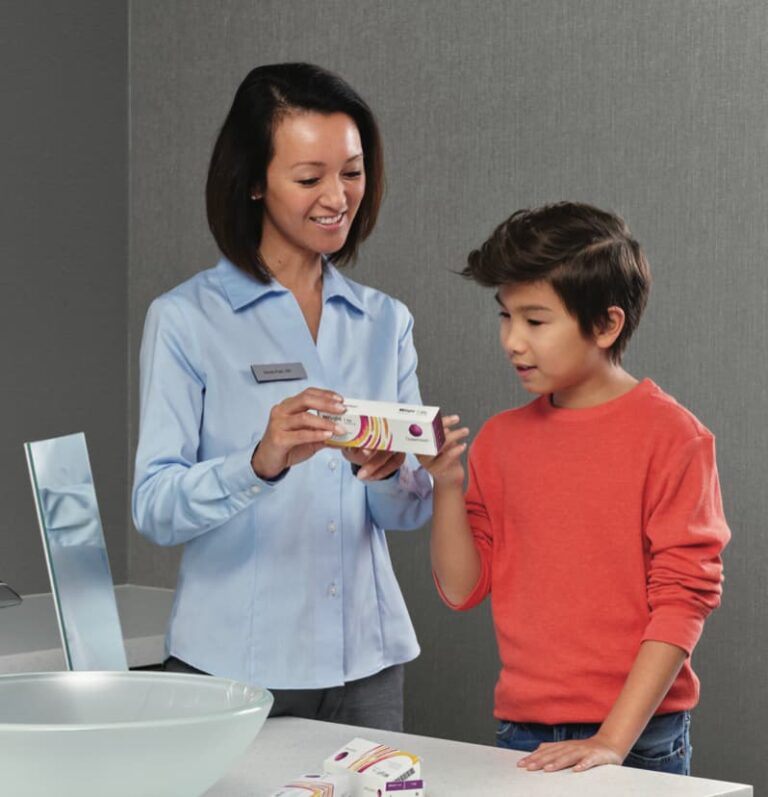
Insertion and removal training: The child and caregiver must demonstrate safe handling. Lenses are not dispensed merely because the prescription is available.
Scheduled follow-up: Vision, fit, eye health, wearing habits, and progression are checked over time. A clear view on one day does not show whether myopia is still progressing.
Daily Wear, Handling, and Parent Support
MiSight is for daily wear and single use. A fresh lens is applied for each day of wear and discarded after removal. The child should follow the prescribed schedule, remove the lenses before sleeping, and keep water away from the lenses and eyes.
Parents or caregivers should know the routine, keep backup glasses available, help the child follow hygiene instructions, and make sure follow-up appointments are kept. A daily disposable schedule avoids cleaning and storing a used lens, but it does not eliminate the risks associated with contact lens wear.
Wash hands with soap and dry them with a clean, lint-free towel before touching a lens or eye.
Use a fresh prescribed lens for each day and discard it after removal.
Never sleep in MiSight lenses and do not expose them to tap, pool, shower, or hot-tub water.
Keep current backup glasses available in case a lens cannot be worn or must be removed.
Remove the lens and contact the eye-care professional promptly for pain, redness, light sensitivity, discharge, sudden blur, or persistent discomfort.
A successful fitting means more than obtaining the right prescription. The lens must provide acceptable vision and comfort, remain healthy to wear, and be used consistently enough for the prescribed plan to be evaluated. Some children need power changes, additional training, a different correction method, or coordinated care.
This page is educational. It does not determine candidacy, prescribe a contact lens, or predict an individual result. Current product labeling and instructions from the prescribing professional control.
No. The current U.S. indication includes children who begin treatment at ages 8 to 12 and meet specific refractive and eye-health criteria. Vision, fit, ocular health, contact-lens readiness, hygiene, and follow-up reliability must also be evaluated.
Bring current glasses, prior contact lenses if any, recent prescriptions, eye-examination reports, and eye-growth measurements when available. A list of medications and relevant medical or ocular history is also helpful.
Follow the schedule prescribed for the individual child and the current product instructions. MiSight is a daily-wear lens, not an overnight lens. It should be removed before sleep and discarded after removal.
No used lens is cleaned or stored because MiSight is single use. A fresh prescribed lens is applied for each day of wear and discarded after removal. Clean, dry hands and water avoidance are still essential.
Handling ability is part of candidacy. Dr. Boshnick and the care team can provide training and assess whether the child and caregiver can use the lenses safely. Another correction option may be more appropriate if handling remains unreliable.
The clinician compares measurements over time, including refraction and, when available and appropriate, axial length. Vision, lens fit, ocular health, comfort, and wearing habits are also reviewed at scheduled visits.
Remove the lens and seek prompt professional guidance for pain, pronounced redness, light sensitivity, discharge, sudden or persistent blur, a white spot on the cornea, or discomfort that does not resolve after lens removal.