

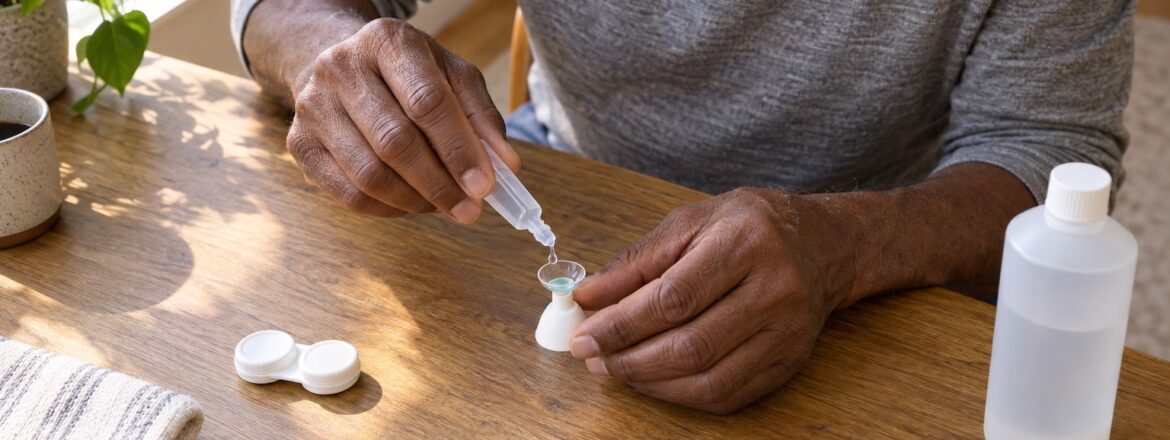
Scleral lens filling solution is the sterile, preservative-free liquid placed in the lens bowl immediately before application; cleaning and disinfecting products are used after wear and should not be trapped against the eye under a scleral lens. These products have different purposes. Use only the exact filling, cleaning, disinfecting, rinsing, and storage products approved by your lens prescriber and permitted by their labels.
Similar bottles and the word “saline” do not make products interchangeable. Because tear exchange beneath scleral lenses is limited, a wrong product may remain against the cornea and cause burning, redness, blur, or toxicity.
The short answer: every solution has one job
A complete care routine commonly includes more than one liquid. Your written plan should identify each product by name and purpose:
- Filling solution: goes into the bowl before the lens is placed on the eye.
- Daily cleaner: loosens deposits from the front and back lens surfaces after removal.
- Disinfecting solution: reduces microorganisms during the required treatment or storage period.
- Rinsing solution: removes cleaner or conditioned storage solution when the care system requires a rinse.
- Lubricating eye drop: may be used on the eye or lens surface only as individually directed.
A multipurpose product may perform several care steps without being a safe reservoir fill. Follow its label and your lens-specific instructions.
What should go in the scleral lens bowl?
The bowl is generally filled completely with a sterile, preservative-free solution recommended by the prescribing clinician. Full filling helps create the continuous fluid reservoir that separates the lens from the cornea and reduces the chance of trapping a bubble during application. The solution must be suitable for prolonged ocular contact.
Do not choose from an online list without checking your written instructions; formulations and labeling can change. A clinician may select a buffered or nonbuffered product based on the eye’s response. The Eye Freedom scleral lenses guide explains the reservoir’s role.
Why preservative-free filling solution matters
Preservatives help keep some multidose products from becoming contaminated after opening. However, when a preserved liquid is sealed beneath a scleral lens, the cornea can receive prolonged exposure. In a sensitive or diseased eye, that may contribute to stinging, redness, epithelial disturbance, or reduced wearing time.
Do not use a preserved filling solution unless the clinician managing your lenses specifically directs it. “Gentle,” “for sensitive eyes,” or “saline” on a label does not prove that a liquid is appropriate for a scleral reservoir. Patients being fitted with scleral lenses for dry eye may be particularly sensitive to unapproved ingredients, but every wearer needs an individualized product plan.
Filling solution and cleaning solution are not interchangeable
| Product role | When it is used | Goes in the bowl for wear? |
|---|---|---|
| Sterile preservative-free filling solution | Immediately before application | Yes, when approved by the prescriber |
| Daily surfactant cleaner | After lens removal | No |
| Gas-permeable multipurpose or conditioning solution | Cleaning, disinfecting, or storage as labeled | No, unless the label and prescriber explicitly say otherwise |
| Hydrogen peroxide system | Disinfection with its specified case and full neutralization cycle | Never as direct fill |
| Tap, bottled, or distilled water | Not part of lens care | Never |
Cleaners remove deposits, while disinfectants require a specified contact time. Filling saline generally does neither. A clear-looking lens can still carry microorganisms.
Never substitute water, saliva, or homemade saline
Never put tap water, distilled water, bottled water, saliva, or homemade saline in the bowl, and do not use them to rinse the lens or its case. Water is not sterile and can contain Acanthamoeba and other organisms associated with serious corneal infection. Distillation or a home recipe does not create a product validated for contact-lens use.
Do not dilute products, transfer them into unsterile bottles, top off old solution, or save spilled fluid. If supplies are unavailable, ask the practice for a compatible alternative.
How cleaning and disinfection protect the lens and eye
After removing a scleral lens, clean both surfaces with the method and digital rubbing time in the prescribed care plan. Rinse with the approved sterile product if the system calls for it. Then place the lens in fresh disinfecting solution for the full labeled cycle. Clean handling tools and replace cases and plungers on the schedule you were given.
An abrasive or incompatible cleaner may damage a lens coating, while heavy deposits may require a clinician-approved treatment. Never polish, boil, scrape, or use household chemicals. The custom fitting process should include a written care plan.
Use hydrogen peroxide systems exactly as labeled
A prescribed hydrogen peroxide system can disinfect gas-permeable scleral lenses, but unneutralized peroxide can cause intense pain and chemical injury. Use only the system’s designated case and catalyst, keep the lens submerged as directed, and wait through the entire neutralization period printed on the label. Do not place peroxide directly on the eye or use it as filling solution.
Use only a compatible case recommended by the clinician or manufacturer. Never move peroxide to another container or shorten its cycle. If exposure occurs, follow the label’s emergency directions and obtain prompt advice.
Manage single-use vials and multidose bottles safely
Packaging affects contamination risk. A single-use vial should be used and discarded according to its label and your prescriber’s instructions; do not assume that “preservative-free” means an opened container remains safe indefinitely. Keep the tip from touching fingers, the lens, the applicator, or another surface.
Multidose preservative-free products still have opening and replacement rules. Close the cap promptly and discard any container that is expired, damaged, cloudy, or mishandled.
Can lubricating drops be added to the reservoir?
Some clinicians direct selected patients to add a compatible preservative-free lubricating drop to the filling solution. This may alter viscosity or comfort, but it is not appropriate for everyone and should not be started from a social-media recommendation. Prescription medication should not be placed in the lens bowl unless the treating clinician gives explicit instructions.
Drops used over a worn lens must also be compatible. Coordinate medication timing with the prescriber, and bring every bottle to appointments for review.
What solution-related fogging or burning can mean
Immediate burning after application can suggest residual cleaner, non-neutralized peroxide, a preserved or otherwise incompatible fill, contamination, or a surface injury. Remove the lens rather than waiting for the sensation to “burn off.” Verify the product and care steps before considering a clean reapplication.
Clouding after several hours can come from material in the reservoir, front-surface deposits, poor wetting, inflammation, or fit—not simply the filling saline. Read why scleral lenses fog for that distinction. Recurrent symptoms deserve examination instead of serial product switching.
Common solution mistakes to avoid
- Filling the bowl with multipurpose cleaning, conditioning, or storage solution
- Assuming any product labeled “saline” is preservative-free and suitable for prolonged wear
- Rinsing with tap water or mixing homemade saline
- Using hydrogen peroxide before complete neutralization
- Reusing old disinfecting solution or topping it off
- Changing brands because one is cheaper or locally available without checking compatibility
- Putting medication or preserved drops under the lens without clinician direction
Check expiration dates and packaging before use. The scleral lens FAQ provides general background; product-specific directions remain controlling.
When symptoms require same-day eye care
Remove the lens and seek same-day eye care for pain, significant or increasing redness, light sensitivity, discharge, a new white spot on the cornea, sudden vision loss, or vision that does not recover after a clean reapplication. Do not keep testing different solutions or repeatedly reinsert the lens. These findings can reflect infection, chemical toxicity, an epithelial defect, inflammation, or corneal swelling.
If non-neutralized peroxide or another chemical entered the eye, follow the product’s emergency instructions and obtain prompt professional guidance. Severe or rapidly worsening symptoms, significant injury, or inability to reach the regular office warrants urgent eye care or emergency evaluation.
Frequently asked questions
Can I fill a scleral lens with regular contact lens solution?
Usually no. Products intended to clean, condition, disinfect, or store lenses may contain ingredients that should not remain in the reservoir. Use only a sterile, preservative-free filling product specifically approved for you.
Is preservative-free saline also a disinfectant?
No. Filling saline generally does not provide the validated microbial disinfection required after wear. Clean and disinfect scleral lenses with the separate system and full contact time prescribed for them.
Can I make scleral lens saline at home?
No. A home mixture is not reliably sterile, may have an incorrect salt concentration or pH, and can expose the eye to microorganisms. Use an approved commercially prepared product.
What if my usual filling solution is unavailable?
Contact the lens practice for a specific compatible alternative. Do not substitute water, a preserved rinse, a storage product, or another person’s solution. Product names and formulations can change.
Bring every product to your next lens visit
A solution review can uncover contamination, a labeling mix-up, coating incompatibility, or a care step that contributes to discomfort. Eye Freedom evaluates lens fit, ocular-surface health, and the complete daily routine for people with irregular corneas and other ocular conditions. Request a consultation and bring the lenses, cases, plungers, filling vials, cleaners, disinfectants, and eye drops you currently use.
This article is general education only. It does not diagnose a reaction, recommend a product for an individual eye, or replace the label, manufacturer instructions, or directions from the professional who prescribed the scleral lens.
Medical references
- Scleral Lens Education Society: Scleral Lens Care Guide
- U.S. Food and Drug Administration: Contact Lens Solutions and Products
- Centers for Disease Control and Prevention: Keeping Water Away From Contact Lenses
- PubMed: Bacteriostatic Effect of Multidose Preservative-Free Buffered Saline Used in Scleral Lens Wear
