


How to Choose a Scleral Lens Specialist
A scleral lens specialist should do more than offer a particular lens brand. A careful provider evaluates the diagnosis and eye health, observes a diagnostic lens after it settles, measures vision through the lens, teaches safe handling, and provides follow-up that can refine both the lens and the care plan.
Proximity can matter for appointments and urgent care, but it should not be the only factor when the eye is medically or optically complex. Patients with keratoconus, severe ocular surface disease, corneal scarring, prior eye surgery, a corneal transplant, or repeated fitting problems may need a practitioner whose clinical experience matches the condition. No credential, device, lens design, or amount of experience can guarantee candidacy or a particular outcome.
For a patient-first explanation of uses, limitations, care, and safety, begin with Eye Freedom’s scleral lenses guide.
Start With the Problem the Lens Needs to Address
Choosing a specialist starts with understanding why a scleral lens is being considered. The fitting priorities for an irregular cornea are not identical to those for ocular surface protection or residual visual symptoms after surgery.
- Keratoconus or corneal ectasia: the evaluation may focus on creating a stable optical surface while monitoring corneal health and lens clearance.
- Severe dry eye or ocular surface disease: tear quality, eyelids, inflammation, surface staining, filling solution, wear time, and the response beneath and around the lens all matter.
- Post-LASIK, post-RK, or other surgical changes: the provider must distinguish ordinary prescription error from irregular astigmatism, higher-order aberrations, ocular surface disease, or another cause of reduced vision.
- Corneal transplant, dystrophy, or endothelial concerns: corneal thickness, endothelial health, oxygen delivery, prior surgery, and coordination with the treating corneal ophthalmologist may affect candidacy and monitoring.
- Prior scleral lens difficulty: fogging, redness, pressure, unstable vision, limited wear, surface deposits, or handling problems need to be investigated rather than attributed automatically to one cause.

Eye Freedom patient video: vision rehabilitation after LASIK complications with scleral lenses.
What Should Happen During a Scleral Lens Evaluation?
The exact sequence varies, but a complete evaluation generally includes:
- History and goals: diagnosis, symptoms, prior procedures, current correction, medications, ocular-surface treatment, lens history, and important visual tasks.
- Eye-health assessment: examination of the cornea, conjunctiva, tear film, eyelids, and other structures relevant to contact lens wear.
- Measurements: corneal mapping and other imaging when those measurements answer a fitting, structural, or optical question.
- Diagnostic lens assessment: observation of corneal and limbal clearance, scleral landing, edge relationship, centration, stability, movement, surface quality, comfort, and tissue response.
- Vision testing: refraction through the lens and investigation of residual blur, glare, halos, ghosting, double images, or variable vision.
- Handling and care training: application, removal, filling, cleaning, disinfection, storage, and recognition of trapped air bubbles.
- Planned follow-up: reassessment after real wear so the fit, eye health, comfort, handling, and vision can be reviewed and refined.
The separate scleral lens fitting guide explains each stage in more detail.

Eye Freedom clinical video: using anterior-segment OCT to evaluate a gas-permeable scleral lens on the eye.
Seven Questions to Ask a Scleral Lens Specialist
1. Do You Routinely Evaluate My Type of Eye Condition?
Ask about experience with the diagnosis and the specific problem you want evaluated. A provider may fit scleral lenses regularly but see fewer eyes with severe ocular surface disease, prior corneal surgery, transplants, or advanced optical symptoms. Experience should be discussed without promising that a similar diagnosis will produce a similar result.
2. How Do You Decide Whether a Scleral Lens Is Appropriate?
The answer should involve eye health, symptoms, prior treatment, examination findings, visual goals, handling ability, and a diagnostic lens response. A diagnosis by itself should not be treated as proof that a scleral lens is appropriate.
3. How Is the Lens Checked After It Settles?
Scleral lenses can change position and clearance during wear. Ask how the provider evaluates the cornea, limbus, landing zone, edge relationship, centration, stability, vision, and tissue response after the lens has had time to settle.
4. What Happens if the First Ordered Lens Needs Changes?
The first manufactured lens may need refinement. Ask how the practice handles design changes, what measurements guide those changes, how vision is retested, and what follow-up is expected. The number of lenses or visits cannot be predicted reliably for every eye.
5. How Are Handling, Cleaning, and Safety Taught?
Patients should receive hands-on instruction and a care plan for their specific lens system. Ask which products are used for cleaning, disinfection, storage, and filling, how air bubbles are recognized, and which symptoms require lens removal and prompt contact with the practice.
6. How Are Persistent Visual Symptoms Investigated?
Blur, glare, halos, ghosting, or double images may have more than one cause. A specialist should consider refraction, lens position, tear-film quality, corneal irregularity, surface deposits, residual astigmatism, and higher-order aberrations before recommending a more complex optical design.
7. What Follow-Up and Urgent Support Are Available?
Ask when the lens will be reassessed, what to bring to follow-up, how changes in fit or vision are handled, and whom to contact for pain, marked redness, discharge, sudden light sensitivity, an unexpected decrease in vision, or a lens that is difficult to remove.
How Much Should Technology Influence Your Choice?
Technology can add valuable measurements, but a device does not replace clinical interpretation or on-eye evaluation. The useful question is not whether a practice owns the longest list of instruments. It is how each measurement changes the examination, lens design, or follow-up decision.
- Corneal topography maps anterior corneal curvature and can document irregularity.
- Anterior-segment OCT can image the relationship between a diagnostic lens and ocular structures.
- Corneo-scleral profilometry may help describe scleral asymmetry and inform more customized landing zones.
- EyePrintPRO impression-based design may be considered for selected complex ocular surfaces.
- Wavefront-guided scleral lens optics may be evaluated when measurable higher-order aberrations remain after the physical fit and lens position are stable.
Not every patient needs every measurement or design pathway. More technology is not automatically better when it does not address a documented clinical or optical problem.

Eye Freedom clinical video: OCT assessment of a scleral lens on an eye with prior Epi-LASIK and corneal transplantation.

Eye Freedom clinical video: ocular surface measurements used to help design a customized scleral landing zone.
Why Follow-Up Is Part of the Prescription
A lens that looks promising during an initial assessment still needs to be evaluated during actual wear. Scleral lens settling, surface wetting, deposits, fogging, lens position, tissue compression, edge relationship, comfort, and visual stability may become clearer over time.
Follow-up also helps the practitioner distinguish a design problem from another issue, such as ocular-surface inflammation, a care product, application technique, lens deposits, prescription change, or progression of the underlying condition. A provider-selection decision should therefore include the quality and availability of follow-up, not only the first fitting visit.
Dr. Edward Boshnick’s Clinical Approach
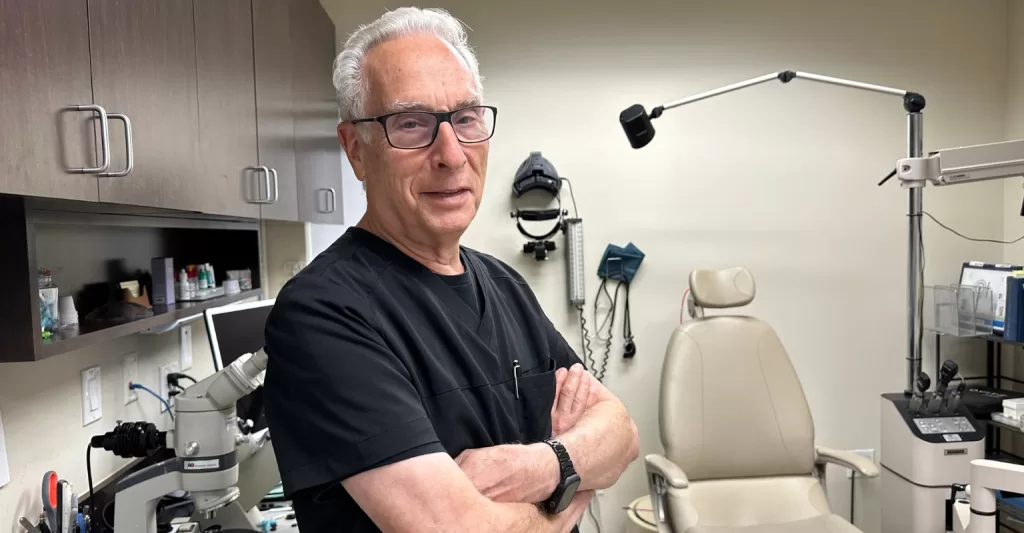
Dr. Edward Boshnick’s clinical work focuses on specialty contact lenses and vision rehabilitation for complex corneal, ocular-surface, and post-surgical cases. His evaluation connects the patient’s symptoms and goals with the eye-health examination, diagnostic imaging, on-eye lens findings, refraction, handling needs, and response during follow-up.
Eye Freedom may use diagnostic-set, scan-guided, impression-based, or advanced optical approaches when the findings support them. The goal is not to assign every patient the most complex technology. It is to determine whether a scleral lens is reasonable and, if so, which measurable design and optical choices deserve evaluation on that eye.
Planning an Evaluation When You Live Far Away
Eye Freedom evaluates patients who travel from many locations. Prior records can help Dr. Boshnick understand the history, but candidacy, measurements, diagnostic lens testing, and the final fitting require in-person care. A remote conversation cannot show how a lens settles or how the tissues respond.
Before making travel arrangements, contact the practice to discuss the reason for evaluation and which records may be useful. These may include current and previous lens parameters, prescriptions, corneal imaging, surgical reports, medication lists, and notes from treating eye-care professionals. The number and timing of visits should not be promised before examination.
Patients traveling a long distance should also maintain access to a qualified eye-care professional near home for emergencies and care that cannot wait for a return visit.
Be Cautious With Guarantees and Superlatives
Claims such as “perfect fit,” “guaranteed comfort,” “best vision,” or “one visit” do not reflect the uncertainty of medical contact lens care. Even advanced measurements cannot guarantee candidacy, vision, comfort, wearing time, or the number of design changes.
Also be cautious when a provider presents one brand, scan, or manufacturing method as automatically superior for every eye. Different eyes can require different design strategies. A trustworthy explanation should include realistic limitations, alternatives, follow-up needs, and reasons a scleral lens may not be appropriate.
What to Bring to a Specialist Evaluation
- All current and previous contact lenses that are available.
- Lens parameters, prescriptions, cases, plungers, and care products.
- Corneal maps, imaging, surgical reports, and relevant medical records.
- A list of eye drops, medications, allergies, and ocular-surface treatments.
- Notes describing when blur, glare, fogging, pain, redness, or reduced wearing time occurs.
- Questions about follow-up, design changes, handling support, urgent symptoms, and travel planning.
Frequently Asked Questions
How do I find a qualified scleral lens specialist?
Look for a provider who evaluates eye health, has experience with your type of condition, assesses a diagnostic lens after it settles, measures vision through the lens, teaches safe handling, and provides planned follow-up. Proximity and credentials can be starting points, but neither replaces a discussion of the actual clinical process.
Is a scleral lens specialist different from a regular contact lens provider?
Some eye-care professionals provide both routine and specialty contact lens care. Complex scleral fitting generally requires additional experience with diagnostic lenses, corneal and scleral relationships, ocular-surface disease, irregular optics, handling instruction, and design refinement. Ask the provider how frequently they evaluate cases like yours and what the fitting process includes.
Should every scleral lens specialist use topography or OCT?
No single instrument is required for every eye. Topography, OCT, profilometry, wavefront analysis, or impression-based systems may be valuable when they answer a specific question. The lens must still be evaluated on the eye, and the findings must be interpreted with symptoms, vision, and eye health.
Is the closest provider always the best choice?
Not necessarily. Distance affects convenience, follow-up, and urgent access, but experience with the diagnosis and the quality of the evaluation may also matter. Patients who travel should plan for the in-person fitting process and maintain appropriate care near home.
How many visits should a scleral lens fitting require?
There is no universal number. The process may include evaluation, diagnostic fitting, dispensing, handling instruction, and one or more follow-up or refinement visits. Anatomy, diagnosis, prior surgery, ocular-surface health, visual goals, handling ability, and the response to each lens affect the timeline.
Can a specialist guarantee that scleral lenses will work for me?
No. A diagnostic lens may provide useful information about potential vision and initial comfort, but it cannot guarantee the final result or predict every issue during longer wear. An examination is needed to determine whether a lens trial is reasonable.
Can Eye Freedom review records before I travel?
You can contact Eye Freedom and provide relevant records before traveling. Records may help with planning, but they do not replace Dr. Boshnick’s in-person examination, measurements, diagnostic lens testing, or follow-up.
How do I request an evaluation with Dr. Boshnick?
Use the Eye Freedom evaluation form or call 305-271-8206. Include the main reason for the evaluation and ask which prior records or lenses would be useful to bring.
Medical and Professional Sources
- Scleral Lens Education Society: patient information about scleral lenses
- Peer-reviewed study: scleral lens prescription and management practices
- Peer-reviewed review: potential contraindications to scleral lens wear
- CDC: cleaning, disinfecting, and storing contact lenses
This article is educational and does not determine candidacy, prescribe a lens design, or predict an individual outcome.
