

EyePrintPRO for Keratoconus: When Is It Considered?
EyePrintPRO may be considered for a person with keratoconus when the corneal or scleral surface is unusually complex, when a lens cannot land or remain stable appropriately, or when prior specialty lenses have not resolved a measurable fitting problem. It is not necessary for every person with keratoconus, and many patients can obtain useful vision with other custom scleral lens designs.
What Is EyePrintPRO?
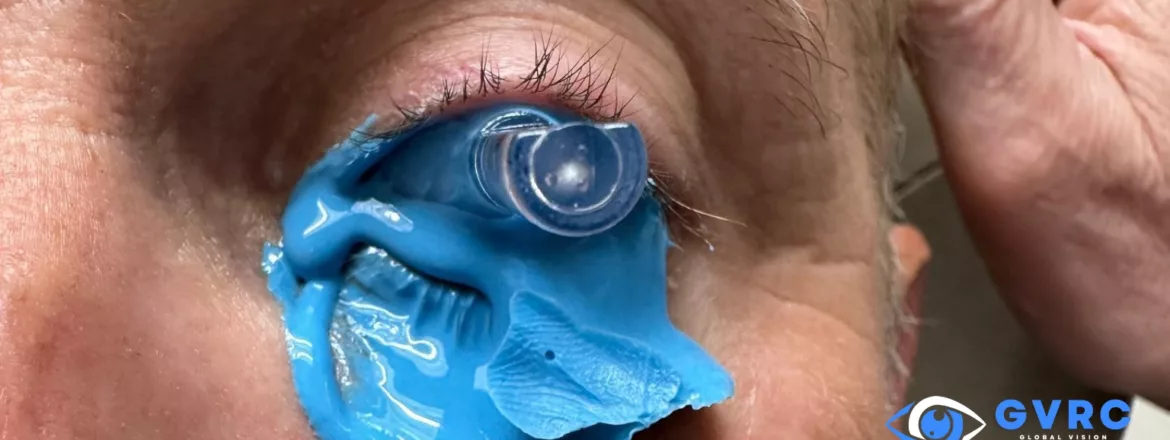
EyePrintPRO is an impression-based prosthetic scleral device. A trained practitioner captures an impression of the ocular surface, which is digitized to help design the back surface of the device. The completed device vaults the cornea and lands on tissue over the sclera while holding a preservative-free saline reservoir over the cornea.
The impression provides detailed information about surface elevation and asymmetry. Optical correction, on-eye assessment, ocular health, handling, and follow-up remain separate and necessary parts of care.
Why Keratoconus Does Not Automatically Require EyePrintPRO
Keratoconus changes corneal shape, but the scleral landing zone also varies from person to person. A conventional custom scleral lens can work well when its vault, limbal clearance, landing, edge relationship, centration, stability, and optics can be adjusted appropriately.
EyePrintPRO should therefore answer a specific fitting need rather than being chosen only because keratoconus is present or because the technology is more advanced.
When Might Impression-Based Design Be Considered?
- marked asymmetry of the corneal or scleral surface;
- localized elevations, scars, surgical anatomy, or other obstacles to even lens landing;
- persistent decentration, rocking, edge lift, or localized compression;
- difficulty maintaining an appropriate fluid reservoir or stable vision;
- limited wearing tolerance associated with a documented fit problem; or
- a history of unsuccessful specialty lens designs despite careful refinement.
Symptoms alone do not identify the cause. Fogging, blur, glare, redness, pressure, and reduced wearing time can arise from different fitting, surface, handling, or optical factors.
What EyePrintPRO Can and Cannot Change
Impression-based design can help customize the physical relationship between the device and a complex ocular surface. By creating a stable anterior optical surface and fluid reservoir, a scleral device may improve vision for selected irregular corneas.
It does not reverse keratoconus or strengthen the cornea. Corneal cross-linking is a separate procedure intended to reduce the risk of progression in appropriate patients. A scleral device is primarily used for vision rehabilitation and, in selected cases, ocular surface support.
EyePrintPRO also does not guarantee elimination of glare, halos, ghosting, or double images. Residual symptoms may involve prescription, lens position, tear-film quality, or higher-order aberrations. Selected patients may need a separate wavefront-guided optics evaluation.
How Dr. Boshnick Evaluates the Decision
- Review the keratoconus diagnosis, progression history, prior procedures, current correction, and visual goals.
- Examine the cornea, limbus, conjunctiva, eyelids, tear film, and ocular surface.
- Use corneal topography, tomography, OCT, or other measurements when they answer a clinical question.
- Evaluate current or diagnostic lenses after settling, including clearance, landing, centration, stability, vision, and tissue response.
- Identify whether the main limitation is fit, optics, ocular surface disease, handling, or another condition.
- Discuss whether a standard custom scleral design, EyePrintPRO, another specialty lens, or additional medical evaluation is most appropriate.
What Happens If EyePrintPRO Is Selected?
The ocular surface impression is obtained and sent for digitization and device design. When the manufactured device arrives, Dr. Boshnick evaluates it on the eye, refines the prescription, and teaches application, removal, filling, cleaning, and disinfection.
Follow-up is part of the process. The device must be assessed after settling and during actual wear. New pain, pronounced redness, discharge, sudden light sensitivity, or an abrupt reduction in vision should be reported promptly.
Frequently Asked Questions
Do all people with keratoconus need EyePrintPRO?
No. Many people with keratoconus obtain useful vision with glasses, corneal rigid lenses, hybrid lenses, or standard custom scleral lenses. EyePrintPRO is generally considered when an impression-based design addresses a specific complexity.
Is EyePrintPRO a treatment for keratoconus progression?
No. It is used for vision rehabilitation and selected ocular surface or fitting needs. Corneal cross-linking is the procedure commonly considered to reduce progression risk in appropriate patients.
Can EyePrintPRO improve vision if another scleral lens did not?
Possibly, but not predictably. A more individualized back surface may improve stability or landing in selected eyes. Vision also depends on the prescription, lens position, tear film, corneal irregularity, and residual optical aberrations.
Does the impression eliminate the need for follow-up?
No. The manufactured device must be evaluated on the eye, and follow-up is needed to assess settling, vision, comfort, handling, and ocular health.
How can I learn whether EyePrintPRO is appropriate for my keratoconus?
A specialty examination is required. Bring prior lens information, corneal imaging, surgical records, and a description of when vision or comfort breaks down.
Related Eye Freedom Resources
- EyePrintPRO technology and fitting guide
- Keratoconus symptoms, diagnosis, and vision options
- Scleral lenses for keratoconus
- Non-surgical keratoconus treatment guide
- Request an evaluation
Medical and Technology Sources
- Peer-reviewed review: contact lens management of keratoconus
- Peer-reviewed report: EyePrintPRO indications and outcomes
- EyePrint Prosthetics: technology and clinical science
- FDA: contact lens safety
This page is educational and does not replace an eye examination, diagnosis, or individualized treatment plan.
